

Non-surgical decompression is a traction-based treatment that aims to create more room around a stressed disc and reduce mechanical pressure on a nearby nerve. When pain shoots down your leg, keeps you awake, or makes standing at the counter feel risky, it is natural to wonder whether spinal decompression therapy is real help or just another promise. That question gets more urgent when you fear surgery may be the only option left. This guide explains what that means, what a session involves, where the limits are, and how people in Plano, Texas can find out whether they may be candidates.
What is the short answer about decompression treatment?
Spinal decompression therapy is a non-surgical treatment that gently changes pressure inside a spinal disc by using a computer-controlled table to apply a slow, measured pull and release rather than a sudden force.
Your spine has discs between its bones, and each disc works like a cushion with a tougher outer layer and softer center. When a disc bulges, herniates, loses height, or becomes irritated, the space around a nerve can narrow. A nerve under pressure may contribute to back pain, leg pain, tingling, numbness, or weakness, although an exam is needed to sort out the cause.
As found by the National Library of Medicine, the goal of decompression is not to force a disc back into place. Instead, treatment creates a controlled change in spinal loading that may temporarily lower pressure within the disc and give an irritated nerve more room.
While many local Plano providers describe decompression as traction designed to reduce disc pressure, the most useful question is not “Does the machine work for everyone?” It is “Does my exam show a problem this approach may fit?”
Why does creating disc space matter to a nerve?
A nerve needs room to move and send signals. When tissue around it is inflamed or crowded, ordinary actions can become hard to predict.
Picture bending to load groceries into the car. Your back may feel manageable until you straighten up, when pain catches and runs from the low back into the buttock or leg. That pattern can happen for several reasons, but a disc-related nerve problem is one possibility because the nerve exits through a small opening beside the spine.
A decompression table is intended to apply traction in a way that changes across the session. The gradual pull matters because the body can tense against a fast or uncomfortable tug. The practitioner can target the lower back or neck while monitoring comfort and adjusting the position.
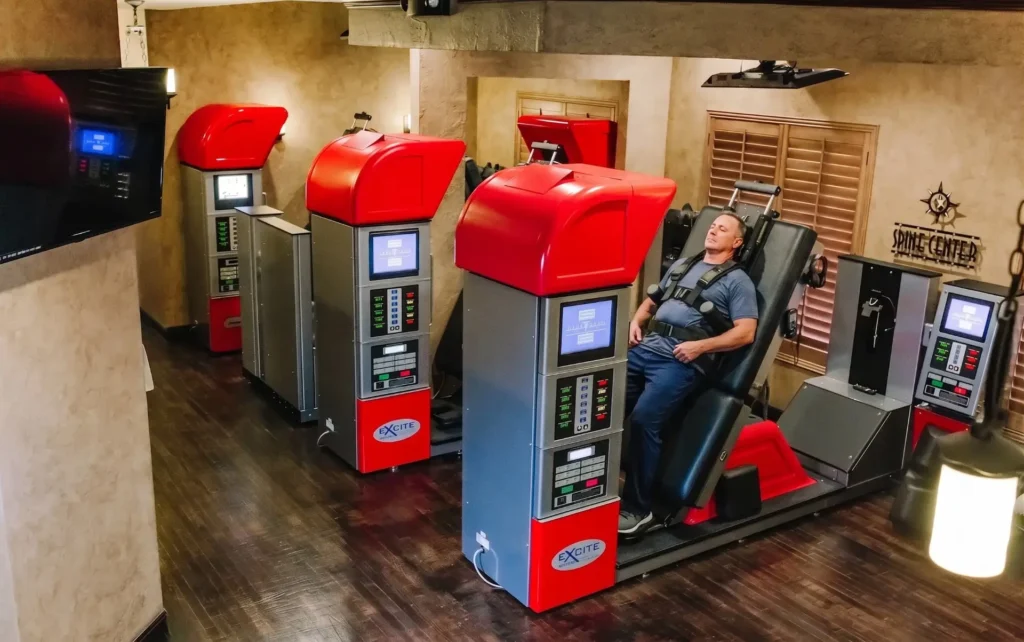
“Creating space” does not mean a large gap suddenly appears between every spinal bone. It means treatment aims to alter loading around a specific spinal area, which may reduce compression forces involving the disc and nearby nerve. Biomechanical studies indicate that altering load and motion can directly influence intradiscal pressure. Some clinics describe this as negative pressure inside the disc, yet that mechanism should not be treated as a guarantee of disc repair or symptom relief.
In my work with people whose pain travels into an arm or leg, the most important detail is usually not the pain score alone. It is whether the symptom pattern, movement findings, and imaging point in the same direction. That is why a careful evaluation comes before a recommendation for decompression.
What does a decompression session actually feel like?
Most sessions feel like a gradual stretch, not a hard pull. You are secured with supports so your body stays in position while the table follows a programmed cycle.
For lower-back care, you generally lie on the table with a pelvic harness around the hips and a support across the upper body. The harness should feel secure without pinching your ribs or pressing sharply into your hip bones. For neck-focused care, positioning differs because the target area and support system differ.
A typical visit may follow this sequence:
- You check in about symptoms. Tell the team where pain travels, whether tingling has changed, and which position made the last day worse.
- The body is positioned for the target area. Your knees, hips, or upper body may be supported so you can settle without bracing against the table.
- The traction cycle begins slowly. You should feel a measured pulling sensation followed by easing, not a jolt or sharp pain.
- Comfort guides adjustments. If a strap rubs, a position raises symptoms, or you feel unsafe, say so while it is happening.
- You stand up carefully afterward. Pause at the table edge until your legs feel steady, especially if pain has made you guard your movement.
Some Plano clinics report sessions under 20 minutes and treatment schedules that may run several times each week, or a month-long schedule. Those are examples of local practice patterns, not a universal prescription. Session length, frequency, and total plan should depend on the findings and your response.
Passive time on a table is only one part of a plan. The value comes from matching it to the right problem, tracking whether your function is changing, and knowing when another kind of care is needed.
Which problems may fit non-surgical decompression?
Disc-related nerve symptoms are the main reason to consider decompression. A name on an imaging report alone does not decide candidacy.
Persistent symptoms may deserve a closer look at disc changes, joint motion, posture, nerve irritation, and the way symptoms behave when you sit, stand, bend, or walk.
An evaluation may consider decompression when symptoms are connected with:
- A herniated or bulging disc that may be affecting a nerve
- Sciatica-like pain that travels from the low back into the leg
- Numbness, pins-and-needles, or burning that follows an arm or leg pattern
- Chronic back or neck pain with findings that suggest disc loading is involved
- Some cases of degenerative disc disease or spinal stenosis, when the full findings support a non-surgical trial
![Dr. Oscar Presas of North Dallas Spine Center explaining a spinal X-ray to a patient in Plano, Texas]](https://northdallasspinecenter.com/wp-content/uploads/2026/09/doctor-explaining-spine-xray-1024x572.webp)
This list is not a self-test. Many people have disc changes on imaging without matching symptoms, while others have pain caused by issues that decompression does not address. A bulge on a scan, for example, does not automatically explain why your calf tingles after ten minutes of standing.
At North Dallas Spine Center, the purpose of the initial review is to look for the structural and tissue factors that may be contributing to pain, then determine whether a non-surgical plan fits rather than assuming the same treatment fits every diagnosis.
When is decompression not the right place to start?
Urgent nerve changes need medical evaluation first. Do not wait for a decompression visit if your symptoms point to a possible emergency.
You need to seek prompt medical care for warning signs, which are often clinical red flags for serious pathologies like cauda equina syndrome, such as:
- New loss of bladder or bowel control
- Numbness around the groin or inner thighs
- Rapidly worsening leg or arm weakness
- A major injury followed by severe spine pain
- Fever, unexplained weight loss, or a history of cancer with new severe back pain
- Pain so intense that you cannot safely stand, walk, or care for yourself
A surgical referral may still be the right step for some people. Severe or progressing neurological loss, certain fractures, infections, tumors, and other serious conditions need medical or surgical care beyond a decompression table. Non-surgical care is not a contest against necessary treatment; it is a path worth assessing when the findings make it reasonable.
Your health history, bone strength, past spine procedures, implants, current symptoms, and imaging findings all matter. That is why an offer that skips the exam and goes straight to a package cannot answer the question you actually have.
How is spinal decompression different from ordinary traction?
The primary difference is that computerized decompression uses changing pull-and-release cycles, whereas ordinary traction applies a steadier, continuous pulling force. Both methods apply traction, but their delivery systems differ.
That difference is often described as a way to reduce the body’s tendency to tighten against the pull. It is a plausible treatment design, not a reason to assume one device will outperform another for every person. Research on traction and decompression has produced mixed results, and promotional clinic pages do not settle that question.
The practical standard is whether the plan has a clear reason, fits your findings, and measures progress by more than “you completed another session.” Better movement, fewer wake-ups from pain, longer standing tolerance, and the ability to get through a work task are more useful markers than a generic promise. (Vanti et al., 2023).
In more than 15 years of practice, I have seen severe disc and nerve cases lose time when treatment decisions were made from a label alone. The people who do best with a next step are usually the ones who first understand what their symptoms and imaging do—and do not—show.
What role does NUCCA care play in this approach?
NUCCA care focuses on upper-cervical alignment and nervous-system balance. It is not the same treatment as lumbar decompression, and it should not be presented as one.
The NUCCA + Spinal Decompression Protocol combines non-surgical decompression with NUCCA upper-cervical correction when the evaluation indicates both parts may be relevant. For someone with low-back symptoms, decompression may be the central discussion. But for someone whose neck pain, headaches, mobility limits, or dizziness raise upper-cervical questions, the examination may point toward a different emphasis.
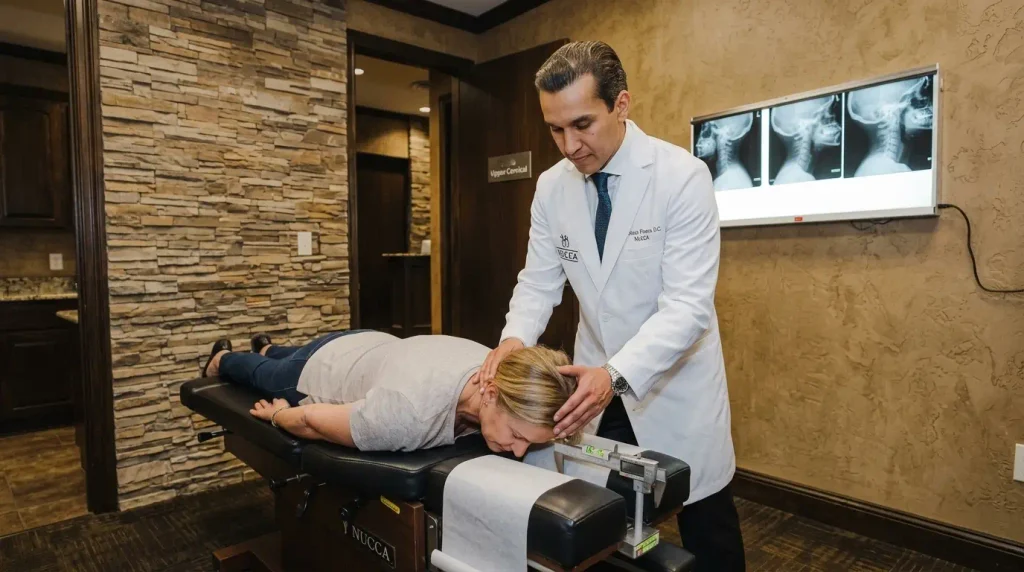
But why combine NUCCA + Spinal Decompression methods?
The point of combining methods is not to pile treatments together. It is to build a plan around what is driving your symptoms and how your body is moving. If the evaluation does not support one part of the protocol, it should not be treated as mandatory.
I became more careful about this after seeing serious herniations, nerve compression, and stenosis cases that did not respond fully to traditional techniques. At 19, a severe lower-back injury left me unable to get out of bed, and the dramatic improvement I felt after my first chiropractic treatment changed my direction; later experience taught me that severe cases need a more exact plan than one standard approach.
What do people get wrong about decompression?
The biggest mistake is treating a machine as the diagnosis. A decompression table cannot tell you what is causing your pain. It should only be considered after an expert gathers enough information to make a reasoned recommendation.
Another mistake is expecting one session to settle a problem that has built over months or years. Some people may notice changes early, while others may not be candidates or may need a different path. At North Dallas Spine Center, noticeable pain reduction and increased mobility may begin as fast as after the very 1st session or within 2–3 weeks for the right candidate, but that is a qualified possibility, not a promise.
Less pain matters, especially when it lets you sleep or walk farther, yet you still need to know what actions are safe, what progress should look like, and when symptoms require another evaluation.
You need to however, avoid these common traps:
- Choosing care based only on an online diagnosis label
- Ignoring new weakness because the pain is temporarily lower
- Staying silent when a treatment position causes sharp or spreading symptoms
- Assuming surgery is inevitable before a non-surgical evaluation has been completed
- Assuming every non-surgical option is appropriate when a surgical referral is medically needed
The better rule is simple: match the plan to the evidence in front of you. That means your symptom history, exam, X-rays when appropriate, and response to care all get a say.
How can you decide whether to explore this in Plano?
Start with an evaluation, not a treatment package. You need a chance to ask what may be pressing on the nerve and whether decompression addresses that finding.
At North Dallas Spine Center in Plano, Texas, the Complimentary Spine Consultation is designed to help determine whether we can help and what may be driving your pain. The visit can include a consult, exam, X-rays, a treatment plan, first-visit Shockwave, and general advice, although the exact components depend on what is appropriate for your visit.
That first visit is not a promise that you are a candidate. It is a way to move beyond guessing when your back keeps going out, your arm feels numb, or leg pain has made you skip another family event. X-rays can show some structural factors, while the exam and your history give those images meaning.
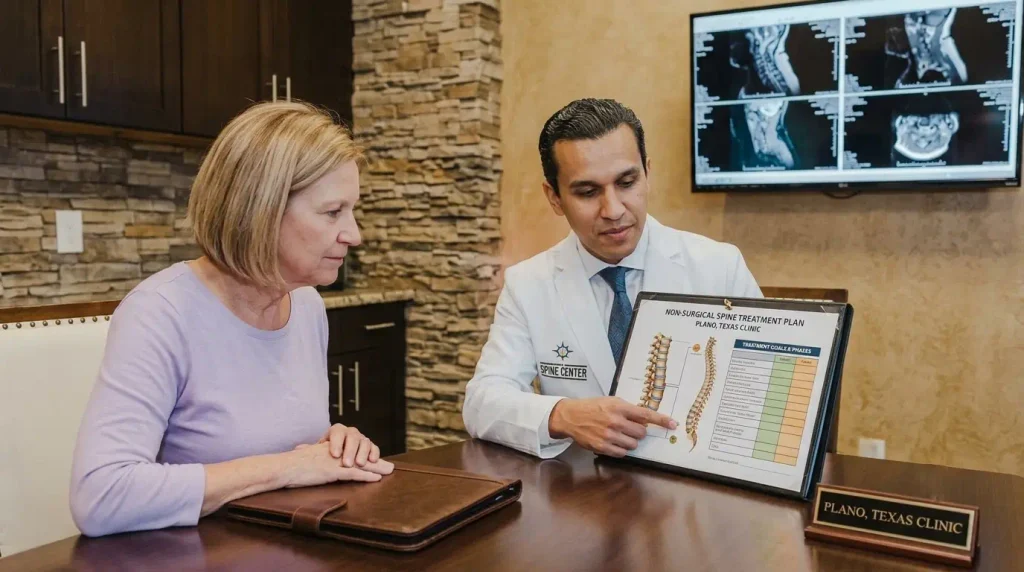
Bring a short timeline of your symptoms, including the movement that triggers them and anything that changes the pain. If you have prior imaging reports, bring those too. Mention past procedures, health conditions, recent injuries, and any new neurological changes, because leaving out a detail can distort the decision.
You can also review Dr. Oscar Presas’s background before your visit. He is a NUCCA Doctor with more than 15 years in practice, has served 500+ clients, and built this approach after seeing severe spinal cases need better options before surgery is considered.
If the findings support it, The NUCCA + Spinal Decompression Protocol gives you a non-surgical plan aimed at reducing nerve pressure and restoring movement rather than asking you to accept pain as a normal part of life. If the findings point elsewhere, knowing that early is still valuable because it helps you take the next appropriate step.
Request a Complimentary Spine Consultation in Plano, Texas to see what may be driving your symptoms and whether you may be a candidate. Consultation times are limited by Dr. Presas’s next-day schedule, so once those visits fill, the next available visit must be booked.
The final decision should rest on your findings, your goals, and your safety—not on fear that you must live with the pain or rush into a path that does not fit. For a person with disc-related nerve pressure, spinal decompression therapy may be the conversation that reveals another option.
Frequently asked questions
What is spinal decompression therapy?
Spinal decompression therapy is a non-surgical treatment that uses slow, controlled traction to change pressure around a spinal disc. The goal is to create more room around an irritated nerve, which may help reduce symptoms such as back pain, leg pain, tingling, or numbness when disc pressure is involved.
How does spinal decompression relieve nerve pressure?
A decompression table applies gentle pull-and-release cycles to a targeted area of the spine. This may reduce loading inside a disc and create temporary space near a crowded nerve. It does not force a disc back into place, and results depend on the cause of your symptoms.
What does spinal decompression treatment feel like?
Most people feel a gradual, controlled stretch rather than a sharp pull. You lie on a padded table with secure supports while the machine follows programmed traction cycles. Tell the clinician right away if positioning causes sharp, spreading, or worsening symptoms.
Who is a candidate for spinal decompression therapy?
People with disc-related back or neck symptoms, sciatica-like pain, tingling, numbness, or certain cases of stenosis may be candidates. Candidacy depends on your symptom history, exam findings, health history, and imaging when appropriate. A disc finding on a scan alone does not prove decompression is the right fit.
Is spinal decompression the same as regular traction?
Both treatments use a pulling force, but computerized decompression uses changing pull-and-release cycles. Standard traction may use a steadier pull. Neither approach is right for every spine problem, so the key question is whether your evaluation shows a condition that may respond to this type of care.
How many spinal decompression sessions will I need?
The number of sessions varies with the area treated, your findings, and how your function changes during care. Some plans involve several visits each week at first, but there is no universal schedule. For the right candidate, noticeable pain reduction and increased mobility may begin within 2–3 weeks.
When should I avoid spinal decompression therapy?
Seek prompt medical care first for new bowel or bladder changes, numbness around the groin, rapidly worsening weakness, or severe pain after a major injury. Certain fractures, infections, tumors, severe nerve loss, implants, and past spine procedures may also affect whether decompression is appropriate.
Where can I get spinal decompression in Plano, Texas?
North Dallas Spine Center offers a Complimentary Spine Consultation in Plano, Texas to determine what may be driving your pain and whether you may be a candidate. The visit can include a consult, exam, X-rays, treatment plan, first-visit Shockwave, and general advice, depending on what is appropriate.