
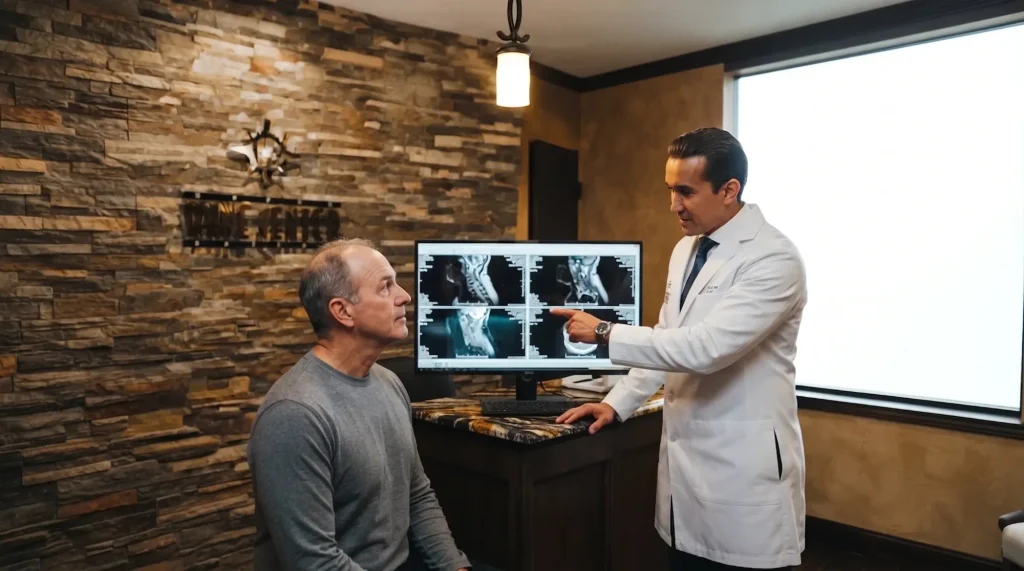
To get an accurate diagnosis from a back pain X-ray, ask your chiropractor these five questions pulled directly from your scan and exam: 1) What structural finding matches my actual symptoms? 2) Does my symptom pattern point to disc or nerve issues the X-ray cannot see? 3) Which findings matter right now versus background age and wear? 4) What did my physical exam show that supports or challenges the scan? and 5) How does this image guide my non-surgical treatment plan?
Reviewing an X-ray provides vital clues about spinal alignment, but pairing these five targeted questions with a hands-on physical evaluation ensures your recovery plan targets the true driver of your pain, not just what appears on an image.
1. What can a back pain X-ray actually show?
A back pain X-ray shows the position and condition of spinal bones. It can help reveal alignment, curves, fractures, arthritis-related changes, joint wear, and changes in disc-space height.
Ask your chiropractor: “What structural finding on my X-ray matches the way my symptoms behave?” A useful answer connects the picture to something real, such as pain that worsens when you extend your back, limited motion when you turn, or a posture that shifts to avoid pain.
Digital X-rays are commonly used by Plano-area spine clinics to look at alignment, curves, degeneration, arthritis, and other structural features. Dallas Spine Center and Best Life Chiropractic in Plano describe this type of structural review, although clinic pages do not prove that an X-ray alone identifies the cause of every painful symptom.

2. Can an X-ray show whether a disc or nerve is causing my pain?
X-rays cannot directly show discs, nerves, or most soft-tissue damage. They may show indirect clues, including disc-space narrowing, but they do not show whether a nerve is inflamed or crowded in the way an MRI can.
Many people assume an X-ray either proves the exact cause or proves nothing is wrong. Neither conclusion is sound. A normal-looking image does not erase pain, and a worn-looking image does not automatically explain tingling in a foot or numbness in an arm.
Ask: “Does my symptom pattern point to something the X-ray cannot see?” If pain travels down one leg, becomes electric when you bend, or comes with numbness or weakness, the answer may be yes. Your history and movement exam help decide whether other imaging, medical evaluation, or a different referral should be considered.
The local sources reviewed for this topic make the same practical distinction. Premier Health Chiropractic’s discussion of disc concerns notes that MRI may be needed when a disc problem is suspected, while its Plano evaluation page describes imaging as one part of a wider assessment.
In more than 15 years of practice, I have seen people fixate on the word “degeneration” in a report when their more useful clue was that pain began running below the knee after ten minutes of standing. The image matters, but the pattern matters with it.
3. Could the changes on my X-ray just be age and wear?
Some X-ray changes are common with age, so they need context before they are blamed for pain. Arthritis, bone spurs, mild curves, and reduced disc height can be relevant, yet they are not a verdict on what you can do or whether your pain will last forever.
The question is whether a finding matches the location, trigger, and behavior of your symptoms.
Consider two people with a similar-looking low-back X-ray. One walks, sleeps, and bends without trouble. The other feels burning down the leg after standing in line and has less strength lifting the front of the foot. Their next steps should not be identical just because one image phrase sounds the same.
Ask your chiropractor: “Which findings matter for me now, and which ones may be background changes?” That question moves the conversation away from fear and toward function. You want to know what limits you today, whether a finding may be putting pressure on nearby tissue, and what needs watching.
A back pain X-ray can be especially helpful when it rules out certain structural concerns or shows why a particular position is not a good fit for you. It is less helpful when it is treated as a complete explanation for every ache, tingle, or weakness.
4. Why do I still need an exam if I already have X-rays?
The exam gives an X-ray meaning by testing how your body moves and functions. It can compare the image with your posture, range of motion, strength, sensation, reflexes, and the positions that bring symptoms on.
Picture bringing in an old report that says “disc narrowing” but being able to point to a more immediate problem: your leg tingles after a short walk, or your back catches when you unload groceries. The examiner can test movements and nerve signs that an image cannot capture, then compare those findings with the X-ray.
Ask: “What did you find on my exam that supports or challenges what the X-ray shows?” A careful answer should be specific. It may explain that your symptoms do not match the image closely enough to assume the finding is the driver, or it may show why the image and exam point in the same direction.
At North Dallas Spine Center, a Complimentary Spine Consultation can include a consult, exam, X-rays, a treatment plan, first-visit Shockwave, and general advice when appropriate for your visit. Its purpose is to determine what may be driving your pain and whether the clinic may be able to help, not to promise that every visitor is a candidate.
I have learned from severe disc and nerve cases that a picture without a careful symptom history can send attention to the wrong place. The most useful detail is often not “my back hurts,” but “my calf burns after I stand for fifteen minutes, then settles when I sit.”
5. What should I ask before agreeing to a treatment plan?
Ask how the proposed plan addresses your findings rather than your X-ray label alone. A plan should have a reason you can understand, a way to track change, and clear limits on when another type of care is needed.
Start with these questions:
- “What do you think is driving my symptoms?” Listen for an explanation that brings together the image, exam, and your daily limits.
- “What can this plan reasonably change?” A clear answer separates goals such as better movement or less nerve pressure from promises the evidence cannot support.
- “How will we know if I am improving?” Track something concrete, such as sleeping longer, walking farther, standing through a meal, or fewer episodes of pain shooting down the leg.
- “What would mean this approach is not right for me?” A trustworthy plan includes referral or further evaluation when the findings call for it.
- “Are there warning signs I should act on right away?” New bowel or bladder changes, numbness around the groin, rapidly worsening weakness, fever with severe back pain, or serious pain after major injury need prompt medical care.
For the right candidate, The NUCCA + Spinal Decompression Protocol uses the NUCCA procedure and Non-Surgical Spinal Decompression to assess upper-spinal movement and disc-related nerve pressure in one non-invasive plan. The point is not to make every X-ray finding fit a pre-set treatment; it is to see whether creating space around a stressed disc and improving movement may fit your actual findings.
A back pain X-ray may be one useful part of that decision, while the exam keeps the image from becoming the whole story. For the right candidate, noticeable pain reduction and increased mobility may begin within 2–3 weeks, though your results depend on the cause of symptoms, severity, health history, and response to care.
What is the next step if my back pain keeps limiting life?
Bring your symptoms, prior reports, and questions to a focused spine visit. Write down when the pain began, where it travels, what makes it worse, and what you have stopped doing because of it.
At North Dallas Spine Center, request a Complimentary Spine Consultation to find out what your exam and X-rays may show about the structural factors behind your pain. Serving Plano and the broader Dallas metropolitan area, Dr. Oscar Presas uses the visit to determine whether you may be a candidate for a non-surgical path or whether another next step makes more sense.
Dr. Presas is a NUCCA Doctor with more than 15 years in practice and has served 500+ clients. After his own severe lower-back injury at 19 left him unable to get out of bed, he learned why persistent symptoms deserve more than a guess based on age or one image.
If back pain has made you skip another family event, lose sleep, or worry that surgery is your only option, request a Complimentary Spine Consultation in Plano, Texas. Consultation times are limited by Dr. Presas’s next-day schedule, and a back pain X-ray can help start the right conversation when it is paired with the full picture.
Frequently asked questions
What can a back pain X-ray show?
A back pain X-ray can show spinal alignment, bone position, fractures, arthritis-related changes, curves, and reduced disc-space height. It helps identify structural factors that may matter. It cannot show every cause of pain, so the image needs to be compared with your symptoms and exam findings.
Can an X-ray show a herniated disc?
An X-ray cannot directly show a herniated disc because discs are soft tissue. It may show reduced space between spinal bones, which can be an indirect clue. An MRI may be considered when symptoms and an exam suggest a disc or nerve problem that an X-ray cannot show.
Can a back X-ray show nerve damage?
A back X-ray does not show nerves or confirm nerve damage. It can reveal bone and alignment changes that may reduce space near a nerve, but it cannot show whether a nerve is inflamed or causing your symptoms. Strength, sensation, reflexes, and symptom patterns help guide the next step.
Why does my back hurt if X-rays look normal?
A normal back X-ray does not mean your pain is not real. Muscle, disc, nerve, and other soft-tissue problems may not appear on an X-ray. Your history and exam can show whether further imaging, medical evaluation, or another care path should be considered.
Do age-related X-ray changes cause back pain?
Age-related changes such as arthritis, bone spurs, and disc-space narrowing are common and do not always cause pain. A finding matters most when it matches where your symptoms occur, what triggers them, and what the exam shows. The same X-ray phrase can mean different things for different people.
When do I need an MRI after a back X-ray?
An MRI may be considered when pain travels into an arm or leg, numbness or weakness is present, or an exam suggests a disc or nerve issue that an X-ray cannot show. New bowel or bladder changes, groin numbness, or rapidly worsening weakness need prompt medical care rather than waiting for routine imaging.
What happens during a back pain X-ray visit?
At North Dallas Spine Center in Plano, Texas, a Complimentary Spine Consultation can include a consult, exam, X-rays, treatment plan, first-visit Shockwave, and general advice when appropriate. The visit helps determine what may be driving your pain and whether you may be a candidate for a non-surgical path. It does not promise that every person is a candidate.